


Table Of Content
- Recap
- Business Outcomes Before Platforms
- Why “AI-Ready” Architecture is About Results, Not Just Technology Choices
- The Great AI-Washing Trap
- Outcomes as the Starting Point
- Stack Choices Matter But It Should Not Be the First Consideration
- What Outcome-Driven Architecture Actually Looks Like
- 1. Modularity over Monoliths
- 2. Feedback Loops Everywhere
- 3. Data-Decision Proximity
- 4. Business-Aware Guardrails
- Beware the “Platform-first” Fallacy
- Final Thoughts: AI-Ready = Result-Ready
Part 5 : Business outcomes before Platforms
Recap:
In Part 1, we talked about the foundational mismatch between traditional ERP/CRM systems and the demands of AI. While these platforms excel at transactions, they were not built to provide intelligence or predictive insights.
In Part 2 we highlighted the critical role of data quality. We saw that before you can dream of AI‑driven transformation, you need to address the messy, scattered, and inconsistent data that too often lives across enterprise systems.
In Part 3 we redefined the data warehouse from being a passive reporting store to the “brainstem” of modern enterprise architecture.
In Part 4 we explored the multi‑cloud AI reality and how to architect for it showing how ERP/CRM systems must extend beyond a single cloud footprint to harness AI across clouds and platforms.
Now, in Part 5, we shift focus from where AI capabilities live to why they matter. It’s time to ask: are we chasing platforms, or are we designing for outcomes?
Business Outcomes Before Platforms
Why “AI-Ready” Architecture is About Results, Not Just Technology Choices
For all the noise around “AI-ready platforms” one uncomfortable truth often gets overlooked: Enterprise Architecture is about the impact that stack enables and not just the tech stack.
Across ERP and CRM programs, we are seeing a shift. The winners in this new wave are not the ones who bought the most cutting-edge tools. They are the ones who built for outcomes first and then chose tools that aligned with those goals. This post is about that inversion. Why AI-ready architecture is about results first, and technology second.
The Great AI-Washing Trap
When vendors say their platform is “AI-ready” they are often referring to built-in ML toolkits, native connectors to LLMs, or no-code workflows for automation. These capabilities are powerful but only if you know what you are solving for.
Too many enterprises fall into the trap of investing in “smart” platforms without embedding those investments into business-critical flows. The result? Proof-of-concepts that never scale, pilots that never productize, and tools that look impressive on paper but deliver little measurable value.
Being AI-ready is not a checkbox. It is a mindset.
Outcomes as the Starting Point
In AI architecture for ERP and CRM, every choice from data modeling to orchestration logic should be traced back to one or more key business outcomes. This sounds obvious, but is rarely practiced with discipline.
Here are examples of what outcome-first thinking looks like:
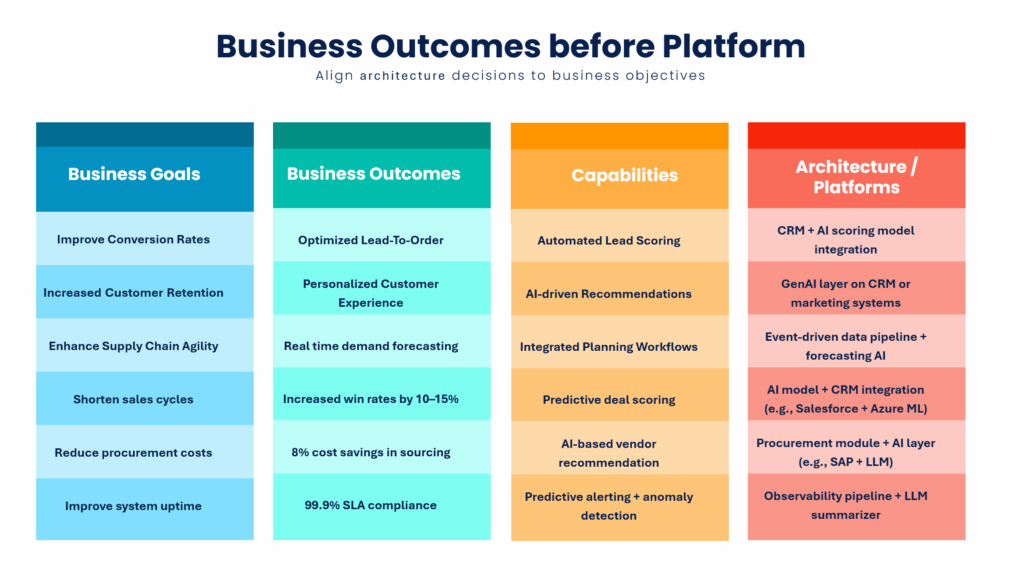
An outcome-first architecture sets up data flows, model triggers, and user interfaces not around the technology’s capability but around what needs to change in the business.
Stack Choices Matter But It Should Not Be the First Consideration
One of the more persistent myths in enterprise architecture is that the “right” platform will guarantee results. Should we go all-in on Databricks? Is Microsoft’s CoPilot stack future-proof?
These are all valid questions just not the first ones.
Before choosing tech, you need clarity on:
- Where the inefficiencies lie
- Which decisions AI can influence
- What data fidelity is needed to support those decisions
- How performance will be measured
Technology enables. It does not define strategy.
What Outcome-Driven Architecture Actually Looks Like
To architect ERP and CRM systems that are truly AI-ready, you need more than LLM plugins and cloud-native backends. You need intention baked into design.
Here is what that looks like in practice:
1. Modularity over Monoliths
Composable services that map to business domains, so that each outcome can evolve independently e.g., credit risk scoring shouldn’t break when customer onboarding changes.
2. Feedback Loops Everywhere
Outcomes improve when the system learns. Did the AI forecast improve stock allocation? Feed the result back into the model. No feedback = no learning.
3. Data-Decision Proximity
Move AI models closer to decision points. For example, embed recommendation engines within CRM workflows, not in a disconnected dashboard.
4. Business-Aware Guardrails
Security and ethics are not separate tracks. They must align with how business leaders understand risk not just how engineers define it.
Beware the “Platform-first” Fallacy
Choosing the most powerful engine does not help if the driver does not know the destination. Similarly, selecting an advanced AI-powered platform does not matter if it does not map to a measurable business goal.
Here is a useful test:
Architecture discussions that focus more on tooling than outcomes tend to drift away from business value.
Final Thoughts: AI-Ready = Result-Ready
The new north star for architecture is measurable business results and not just interoperability or scalability.
As architects, we must rewire our instincts:
- From platform evaluation to problem definition
- From feature checklists to value KPIs
- From “what can AI do?” to “what should AI change?”
Because at the end of the day, being AI-ready is not about how many LLMs you have tested or which stack you prefer. It is about whether your architecture helps the business win faster, smarter, and with clarity.