


Table Of Content
- Data Consolidation : Pulling Multiple Streams Into One Frame
- What Actually Happens in Data Consolidation
- Data Enrichment : Filling the Gaps and Adding Meaning
- What Actually Happens in Data Enrichment
- Common Challenges in Consolidation and Enrichment
- Where the Friction Really Shows Up
- Closing Thoughts
- Up Next
In Part 1, we saw how Master Data Management (MDM) acts as the spellbook that brings order to enterprise chaos by defining, governing, and connecting critical data to create the Golden Record, your organization’s single version of truth.
In Part 2, we stepped into Diagon Alley, where the journey truly began. Collecting the right data from the right sources. Because before you can cleanse, enrich, or consolidate, you need to gather your essentials i.e. the building blocks of every future insight.
In Part 3, we entered The Sorting Ceremony, where your collected data finds its rightful place. This stage is about cleansing, correcting, and categorizing i.e. transforming messy, inconsistent information into structured, reliable data that your entire organization can trust.
Part 4 – The Room of Requirements: Data Consolidation & Enrichment
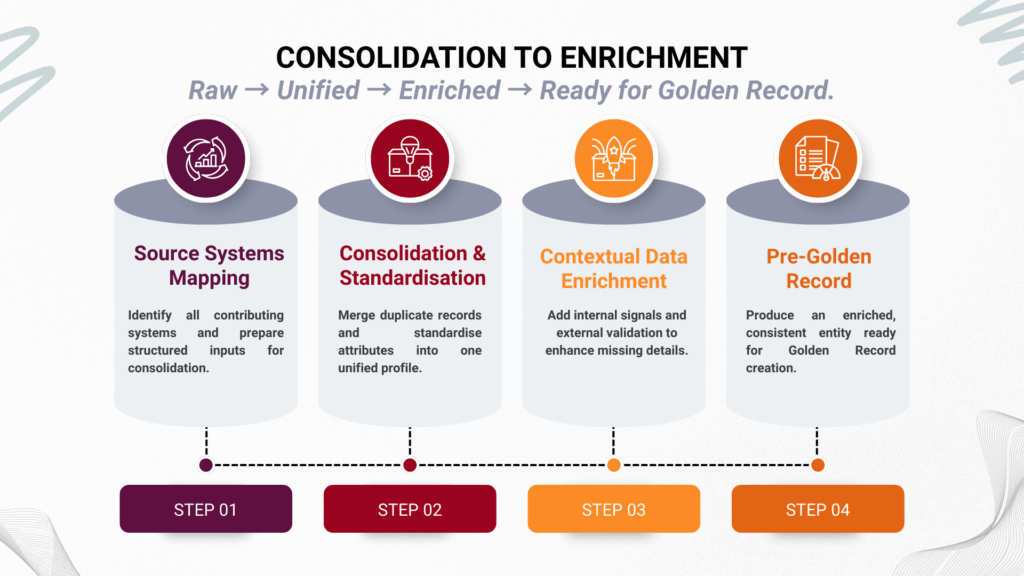
Data Consolidation : Pulling Multiple Streams Into One Frame
Think of all your systems as people describing the same customer in different accents. One system knows their email, another knows their purchase history, another still uses an old phone number. Consolidation brings these voices together and decides which one should speak for the truth.
Data consolidation is the moment these scattered storylines come together. Imagine placing all those overlapping records on a table and slowly sliding them toward the centre until they align. Some fields match perfectly, some contradict each other, and some are simply missing. The goal is to understand the origin, reliability, and context of each piece of information so that a unified truth can emerge.
At its core, consolidation involves recognising when multiple records actually represent the same entity. This is harder than it sounds. One system may store full names, another uses initials. A phone number might appear in different formats. Addresses may vary depending on whether they came from a form submission or a verified service. Consolidation brings order to this chaos by evaluating similarities, resolving conflicts, and deciding which attributes should survive based on trust, recency, and business rules.
And this is where the nuances show up. Two records might look identical until you notice a timestamp that suggests one is more recent. Another record may hold a field that no other system captured but is critical for compliance. Consolidation weighs these differences carefully. It doesn’t blindly merge; it reasons. It prioritises. It creates structure out of inconsistency.
By the end of this stage, the organisation hasn’t built the Golden Record yet but it has done something equally important. It has created a single, unified version of each entity that finally stops systems from contradicting each other.
You now have the foundation. The skeleton. The harmonised identity upon which everything else will be built.
What Actually Happens in Data Consolidation
Record Matching and Entity Resolution
Systems often describe the same person or product in different ways. Matching algorithms compare names, emails, phone numbers, and metadata to determine when two records belong to the same entity. This step prevents duplication and fragmentation.
Field-Level Conflict Resolution
When systems disagree like two different addresses, two versions of a name , consolidation evaluates source quality, recency, and reliability. The most trustworthy value is chosen, and the rest are archived for lineage.
Survivorship Rules
These are the business rules that decide which data “wins” when merging records. For example, CRM might always be the authoritative source for contact details, while ERP might take priority for billing information.
Standardising Identity with Unique Keys
Every consolidated entity receives a stable, unique identifier so downstream systems can reference it consistently, regardless of where the original records came from.
Lineage and Traceability Capture
Consolidation keeps a breadcrumb trail: where each attribute came from, why it was chosen, and how it changed. This ensures audits, analytics, and future updates remain transparent.
Data Enrichment : Filling the Gaps and Adding Meaning
Once the dust settles from consolidation, something interesting becomes visible. The unified record is now consistent and conflict-free, but it still feels a little plain. It tells you who the customer is, but not much about what they do, how they behave, or what context surrounds them. In other words, the skeleton is assembled, but the muscle and detail haven’t formed yet.
This is where enrichment enters the picture.
Think of enrichment as switching from a simple line sketch to a fully coloured illustration. The outline was necessary, but now the real personality starts to emerge. Internal systems add behavioural signals. External sources validate missing details. AI models help classify and interpret patterns. Bit by bit, a minimal identity grows into a complete profile.
Enrichment isn’t about adding data for the sake of volume. It’s about increasing meaning. A customer with just a name and address tells you very little. A customer enriched with segment labels, verified contact details, purchase history, risk scores, and engagement patterns suddenly becomes far more valuable — for operations, analytics, customer experience, and compliance.
And just like consolidation, enrichment requires judgment. Not every external source is trustworthy. Not every attribute is helpful. Some information introduces noise instead of clarity. Good enrichment is discerning. It knows what to keep, what to validate, and what to let go.
By the end of this stage, the organisation has moved beyond simply agreeing on a unified record. It now has a record that is complete, contextual, and ready to be used in real business workflows. This enriched identity is still not the Golden Record but it’s the closest the data has ever been to operating in its final, authoritative form.
What Actually Happens in Data Enrichment
Internal Enrichment: Adding What Your Organisation Already Knows
After consolidation, the next step is pulling in signals from operational systems like purchase history, interaction logs, communication preferences, support behaviour, and lifecycle events. These attributes transform a static profile into one that reflects reality.
External Enrichment: Validating and Completing Missing Details
Third-party services strengthen the record by verifying addresses, validating emails, enriching demographic data, or adding firmographic attributes such as industry codes or registration details. This fills gaps that internal systems alone cannot cover.
Semantic or AI-Driven Enrichment
Classification models, embeddings, and pattern-recognition tools assign categories, cluster similar entries, generate risk scores, or identify behavioural segments. This adds interpretive layers that raw data could never provide on its own.
Consistency and Quality Checks
Newly enriched attributes are evaluated for accuracy, relevance, and recency. Enrichment is valuable only when the added data is reliable. Any inconsistencies or suspicious values are flagged before they enter downstream systems.
Context Building
Enrichment links related pieces of information like a purchase becomes part of a trend, a support ticket becomes an indicator of dissatisfaction, a location becomes part of a geographic cluster. The record becomes a living, contextual profile.
Common Challenges in Consolidation and Enrichment
On paper, consolidation and enrichment look like mechanical steps: match the records, merge the fields, add missing context, validate the results. However, this is the stage where most organisations quietly struggle. And this might not be necessarily because the technology is inadequate, but because data has a personality of its own! They are unpredictable, inconsistent, and shaped by years of human habits, system shortcuts, and operational pressures.
The first challenge appears the moment two records look similar but not identical. Should they be merged? Should they remain separate? A single character difference in a name or a missing unit number in an address can change the outcome entirely. Automated rules help, but edge cases always exist, and they rarely announce themselves politely.
Then there’s the issue of trust. Not all systems are equal. Some are well-maintained and updated daily. Others contain legacy data from a decade ago. A marketing spreadsheet might hold a “new” phone number that turns out to be outdated. An external data provider may correct an address but introduce a formatting variation that looks suspicious. Consolidation and enrichment constantly balance source reliability, business logic, and real-world messiness.
Scale adds its own complexity. A few hundred records can be reviewed manually. A few million cannot. Patterns that look consistent in small samples fall apart when volume increases. Exceptions multiply. Rules that worked perfectly in controlled testing start failing when exposed to diverse data from across the enterprise.
And finally, there is the human element. Data owners have opinions. Business units have preferences. Compliance mandates introduce restrictions. Every entity be it customer, supplier, employee, product carries history and expectations. Consolidation and enrichment touch all of them, which means disagreements are guaranteed.
This doesn’t mean the process fails. In fact, it’s these challenges that ultimately shape a stronger, more thoughtful master data framework. But it’s important to acknowledge that data rarely behaves as cleanly as diagrams suggest. Knowing the friction points upfront makes the journey smoother and decisions more defensible.
Where the Friction Really Shows Up
Duplicate Records That Look “Almost” the Same
Name variations, spelling differences, formatting inconsistencies, and outdated fields make matching harder than expected. Many records fall into the grey zone where neither a definitive match nor a clear separation is obvious.
Conflicting Values With No Clear Winner
Two systems may claim ownership of the same field both with plausible values. Without agreed-upon survivorship rules, these conflicts stall decision-making or lead to inconsistent downstream outputs.
Unreliable or Incomplete Data Sources
Legacy systems, manual uploads, spreadsheets, or unverified external datasets often introduce gaps or errors. Poor-quality inputs create poor-quality outputs, no matter how sophisticated the pipeline is.
Rules That Don’t Scale
Matching logic or enrichment workflows that work perfectly for a small dataset often break when millions of rows arrive with unexpected variations.
Data That Changes Faster Than Governance Can Keep Up
Customer information, product details, and supplier attributes evolve constantly. Without continuous monitoring, a consolidated record can become outdated surprisingly quickly.
Organisational Misalignment
Different teams may have different definitions of “truth”. One team wants recency; another prefers verified sources; another cares about compliance lineage. The lack of a shared standard slows consolidation.
Closing Thoughts
We often imagine data as something static : fields, tables, and systems. But what we build through consolidation and enrichment is far more alive. It’s a living, breathing map of real entities: customers, products, suppliers each with a history, relationships, and evolving context.
Consolidation brought coherence. Enrichment gave depth.
Together, they transformed fragmented pieces into meaningful, usable profiles. What remains is the foundation of clarity, trust, and shared understanding across the organisation.
At the end of Part 4, you don’t yet hold the “Golden Record.” What you have is the readiness i.e. the carefully prepared data, with lineage, context, and quality that make a true master record possible. That readiness matters.
Up Next:
Part 5 – we’ll finally bring all this preparation together and create the Golden Record itself i.e. the single, authoritative source of truth. It’s where consolidation and enrichment evolve into something official, governed, and ready to power the entire enterprise.