


Table Of Content
Architecting ERP & CRM for AI in a Multi-Cloud World
Preface:
Over the last decade, many organizations poured significant resources into ERP and CRM transformations like digitizing operations, streamlining workflows, and improving visibility across the business and these systems were built to last.
But here’s the catch: they were not built for what is coming next.
The AI era has arrived with real, tangible expectations from the business. Leaders want intelligent automation, predictive insights, and personalized experiences at scale. And they expect it to happen on top of systems that were never designed with AI in mind.
That is the tension this series explores.
“Rewiring the Core” is a 10-part series focused on enterprise architecture through a very specific lens:
- Clean, governed data
- Business outcome–driven design
- ERP and CRM systems that are ready for AI
- And the messy reality of working in a fragmented, multi-cloud world
This is not a theoretical take. It is grounded in real enterprise challenges and architecture trade-offs meant for IT leaders, architects, and transformation teams who are rethinking how to connect the old with the new.
The systems that helped us scale yesterday were not built to think for tomorrow. AI would not unlock its full potential until we rewire the foundations it stands on.
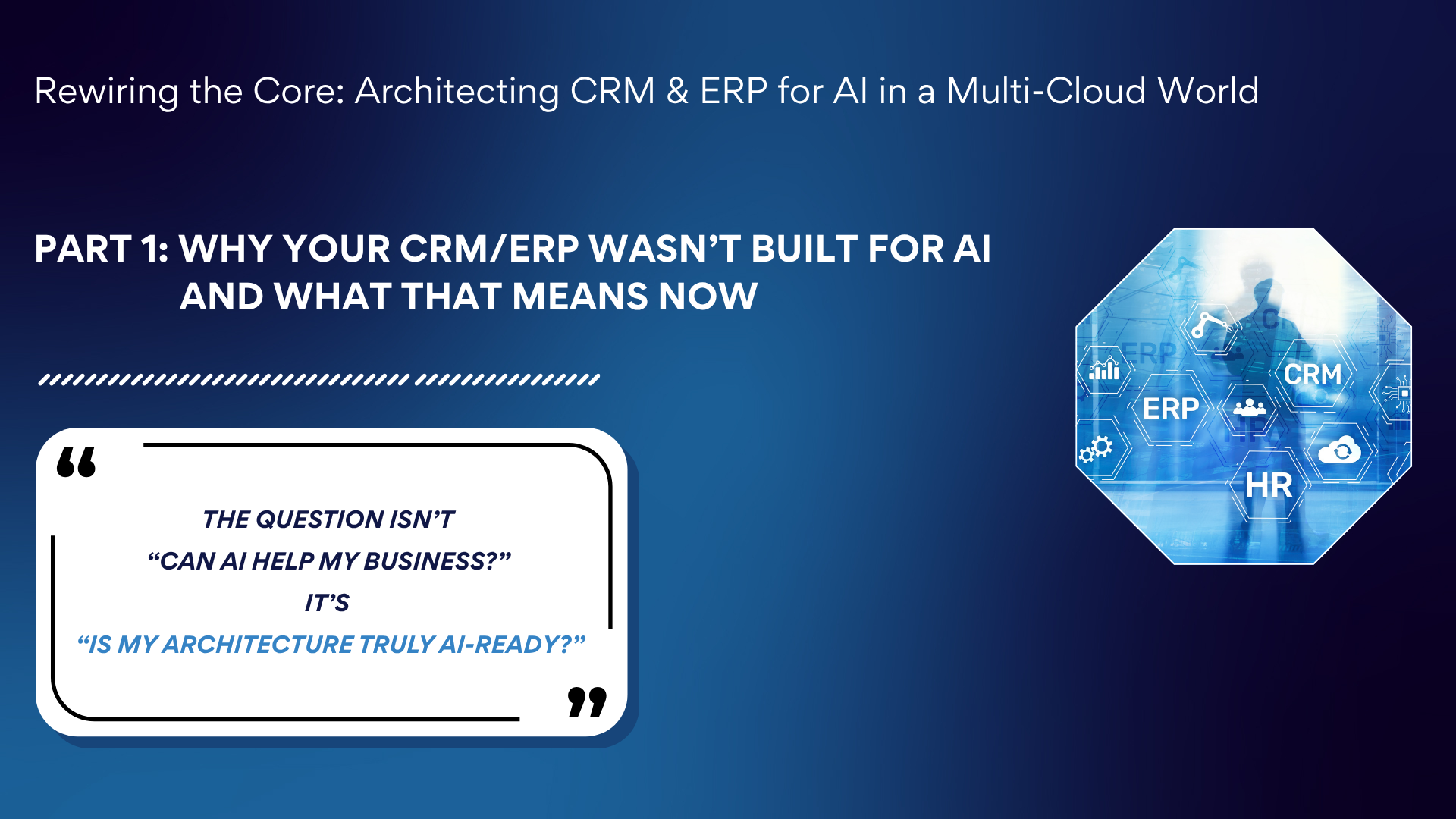
Part 1: Why Your ERP/CRM Was Not Built for AI and What That Means Now
ERP and CRM systems were built with a singular mission: ensure consistency, reliability, and transactional integrity across the business.
And they have done that well powering everything from financial closings to lead management with structure and repeatability.
But then AI entered the room. And suddenly…
- Your systems do not speak the language AI needs.
- Your data is not where your AI lives.
- Your architecture cannot flex for experimentation.
Why? Because your ERP/CRM systems were not designed to learn. They were designed to record.
Legacy Architecture: Built for Control, Not Curiosity
Most ERP/CRM systems in place today were designed 3–10 years ago when AI was still a boardroom curiosity, not a business capability. That meant:
- On-prem deployments with tightly coupled logic
- Monolithic architectures that resist modularity
- Custom code sprawl across workflows
- Point-to-point integrations for specific needs do not scale
This architecture was not wrong. It was just optimized for a different world.
But now, we’ve entered an era where
- Business users expect predictive suggestions and automation natively.
- AI platforms sit in external clouds (e.g., Azure OpenAI, AWS Bedrock).
- Real-time data movement across systems is assumed, not optional.
And these legacy systems? They are straining under the weight of expectations they were not built for.
The Multi-Cloud Challenge
To make things even more complex, most enterprises now operate in a multi-cloud reality:
- ERP might still be hosted on-prem or in a private cloud
- CRM could be SaaS (like Salesforce or Dynamics 365)
- AI/ML platforms are often on a different cloud altogether
This leads to fragmented architectures with multiple issues:
- Data latency between systems
- Inconsistent semantics and identity resolution
- Security and compliance challenges
- AI models trained on stale, misaligned, or incomplete data
The result? A fancy AI engine that technically works, but does not deliver value because it’s disconnected from the core systems of record.
From System of Record to System of Intelligence
To move forward, organizations need to shift their architectural thinking.
It is no longer enough to maintain systems of record. We must evolve toward systems of intelligence where clean data, flexible architecture, and aligned outcomes enable AI to operate as a value creator, not a bolt-on tool.
That means:
- Designing for clean, governed, and AI-consumable data
- Investing in real-time or event-driven integrations
- Replacing point-to-point connections with modular, interoperable layers
- Creating a blueprint that bridges ERP, CRM, AI, and automation layers
The question is not “Can AI help my business?” It is “Is my architecture truly AI-ready?”
Up Next:
Part 2 : You Cannot Plug AI into a Mess We’ll explore why clean data is not just a tech requirement ; It is an AI enabler, and the foundation of any outcome-driven transformation.