


Table Of Content
- Recap
- Why AI-Ready Architecture Needs AI-Ready Operating Models
- A Little walk in History
- The Core Challenge: From Project Delivery to Product Outcomes
- Tech Won’t Save You from a Broken Org Model
- Practical Framework on Evolution of Org Stack
- How to Read This Transformation Guide
- Org Stack
- The Evolution Mindset: Same Foundation, Expanded Capabilities
- Build Teams Like You Build Systems
- 1. Departments (Not Domains)
- 2. Platform Teams as Enablers
- 3. Decision Proximity
- Final Thoughts: Org Design is Architecture Too
- Up Next
Part 6 : The Org Chart is the New Stack
Recap:
In Part 1, we talked about the foundational mismatch between traditional ERP/CRM systems and the demands of AI. While these platforms excel at transactions, they were not built to provide intelligence or predictive insights.
In Part 2 we highlighted the critical role of data quality. We saw that before you can dream of AI‑driven transformation, you need to address the messy, scattered, and inconsistent data that too often lives across enterprise systems.
In Part 3 we redefined the data warehouse from being a passive reporting store to the “brainstem” of modern enterprise architecture.
In Part 4 we explored the multi‑cloud AI reality and how to architect for it showing how ERP/CRM systems must extend beyond a single cloud footprint to harness AI across clouds and platforms.
In Part 5 we flipped the script on “AI-ready” architecture showing that it is not about which platform you choose, but whether your architecture delivers measurable business outcomes.
Now, in Part 6, we zoom out from systems and stacks to look at something just as critical: people. Specifically, how your org structure shapes (or stifles) your ability to deliver AI-driven ERP and CRM transformation.
Why AI-Ready Architecture Needs AI-Ready Operating Models
You can build the most elegant architecture in the world, but if your teams are trapped in legacy silos, decisions will stall, insights would not scale, and “AI-powered” will remain a slogan. In the enterprise AI era, technology doesn’t just need new platforms it also needs a new operating model.
That is why, increasingly, the org chart is the new stack. Your AI architecture will only be as effective as the people, processes, and power structures that support it.
A Little walk in History:
You know how football used to be all about running the ball? When teams started throwing more passes, they didn’t fire their players. They just trained them differently. From the 1920s through the late 1970s, the NFL was dominated by a grinding, run-heavy style built around legends like Jim Brown and Walter Payton. But after the pivotal 1978 rule changes that favored passing, the game transformed into today’s pass-first spectacle.
The genius wasn’t in replacing running backs and linemen, rather, it was in expanding their capabilities. Running backs learned to catch passes, offensive linemen mastered pass protection, and defensive players adapted to cover complex passing routes. The players who thrived were those who added new skills to their existing foundation of football intelligence and athletic ability.
Similarly, your enterprise teams aren’t becoming obsolete in the AI era, they are evolving into AI-amplified teams with expanded capabilities. The foundation remains the same: business knowledge, technical expertise, and proven execution. What changes is the addition of AI literacy, data fluency, and outcome-driven thinking.
The Core Challenge: From Project Delivery to Product Outcomes
Historically, ERP and CRM programs were driven by IT. But in the AI era, ownership must shift toward outcomes with distributed teams co-owning data and intelligence loops.
What this demands:
- Cross-functional squads that span business + data + platform
- Data product ownership: treat domains like customer, pricing, or supply chain as products, with dedicated stewards
- Embedded AI literacy: domain leads must understand enough to apply and govern AI apart from consuming reports
Tech Won’t Save You from a Broken Org Model
Many transformation failures aren’t organizational. The ERP system was upgraded. The CRM got smarter. The data lake was modernized. And yet… nothing changed.
Why? Because:
- Marketing still doesn’t trust Sales’ data
- AI models live in a data science “lab” not embedded in decision flows
- The ERP upgrade team never talked to the customer support team
- Business users still file tickets to get access to insights
The problem is your structure. A transformation is needed which involves evolution at every level of your organization.
Remember: We are not redesigning jobs from scratch. We are showing how your existing expertise becomes more powerful when combined with AI capabilities!
Practical Framework on Evolution of Org Stack
How to Read This Transformation Guide
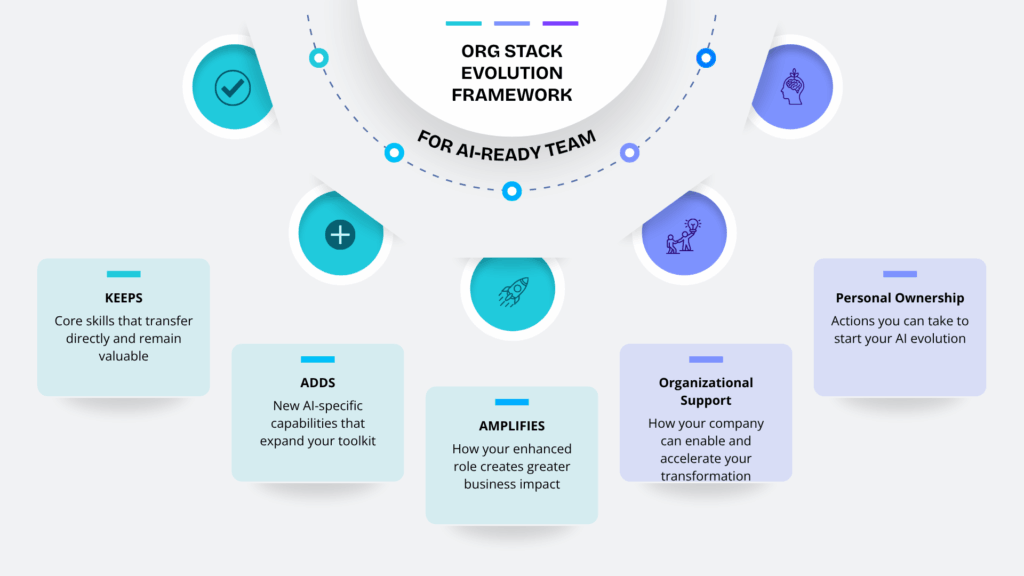
The sections that follow map out role evolution across every layer of your enterprise from C-suite executives to individual contributors. For each role, you will see a consistent pattern:
Role Enhancement Framework:
- Keeps: Core skills that transfer directly and remain valuable
- Adds: New AI-specific capabilities that expand your toolkit
- Amplifies: How your enhanced role creates greater business impact
Dual Responsibility Structure:
- Personal Ownership: Actions you can take today to start your AI evolution
- Organizational Support: How your company can enable and accelerate your transformation
This is a practical exercise. Every role evolution we describe is already happening in leading enterprises. The question is whether your organization will guide them intentionally or let them happen by accident!
Org Stack
Note: To access the complete role transformation toolkit with detailed evolution frameworks, skills mapping, and implementation guidance for your specific role, please submit form here. You’ll receive the full editable presentation featuring in-depth analysis and actionable strategies for requested role’s AI transformation journey.
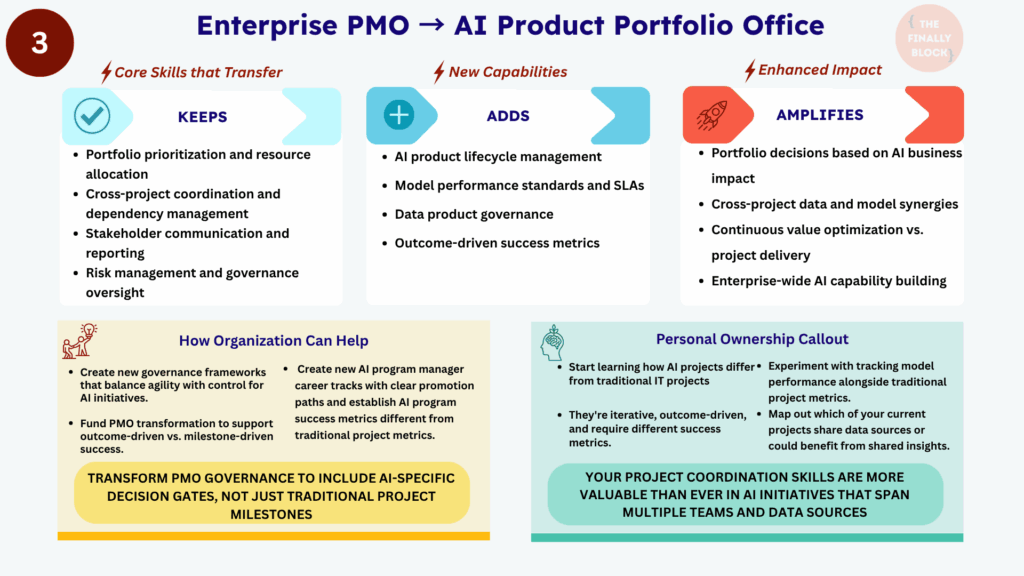
Example Role Slide:
| Role Name | Evolves To | Role Enhancement Summary | Dual Responsibility Summary |
|---|---|---|---|
| Executive – Chief Information Officer | Chief Data & AI Officer | Expands from technology strategy to intelligence-driven business transformation, adding AI strategy, data monetization, and algorithmic governance to traditional IT leadership. | Org Help: Make AI strategy a board-level discussion, not just an IT initiative Personal Ownership: Don’t wait for board mandate. Identify business processes where AI drives measurable outcomes |
| Executive – Business Unit Head | AI-Enabled Business Leader | Evolves from traditional business management to data-driven strategic leadership, incorporating AI ROI measurement and intelligent automation into P&L responsibility. | Org Help: Give business leaders direct control over AI pilot budgets without IT approval Personal Ownership: Don’t wait for IT solutions. Identify expensive manual decisions that AI could optimize |
| Program/ Portfolio Management – Enterprise PMO | AI Product Portfolio Office | Transforms from project governance to AI product lifecycle management, adding model performance standards and outcome-driven metrics to traditional portfolio oversight. | Org Help: Transform PMO governance to include AI-specific decision gates, not just traditional milestones Personal Ownership: Don’t wait for AI projects. Learn how AI projects differ with iterative, outcome-driven success metrics |
| Program/Portfolio Management – Program Manager | AI Product Portfolio Manager | Evolves from multi-project coordination to AI capability orchestration, adding cross-program AI coordination and talent allocation to resource management skills. | Org Help: Give program managers budget authority for shared AI resources serving multiple programs. Personal Ownership: Don’t wait for individual coordination. Identify programs that could benefit from shared AI capabilities |
| Program/Portfolio Management – Senior Project Manager | AI Product Manager | Shifts from delivery-focused management to outcome-driven product ownership, adding model performance tracking and continuous value optimization to project leadership. | Org Help: Create success metrics balancing delivery milestones with business outcomes and user adoption Personal Ownership: Don’t wait for data science teams. Learn to measure AI success by business impact, not just delivery |
| Architecture – Enterprise Architect | AI Systems Architect | Expands from system integration to enterprise intelligence architecture, adding multi-cloud AI integration patterns and model serving architectures to enterprise design. | Org Help: Give enterprise architects authority over AI architecture standards and review board decisions Personal Ownership: Don’t wait for AI team. Understand current data flows as foundation for AI architecture |
| Architecture – Platform Architect | AI Platform Architect | Evolves from platform strategy to AI/ML platform governance, adding model serving infrastructure and AI platform cost optimization to traditional platform management. | Org Help: Give platform architects veto power over AI tool proliferation and redundant platform purchases. Personal Ownership: Don’t wait for data science teams. Evaluate AI platforms like any enterprise platform for scalability and governance |
| Architecture – Data Architect | Enterprise Data Architect | Expands from data design to AI-consumable data architecture, adding real-time data serving for AI models and data product architecture to enterprise data modeling. | Org Help: Give data architects cross-business-unit data sharing authority to override departmental silos. Personal Ownership: Don’t wait for AI teams. Design data architectures assuming AI consumption from day one |
| Architecture – Solutions Architect | Domain AI Architect | Evolves from application integration to intelligent business solutions, adding AI-native application patterns and intelligent workflow orchestration to domain expertise. | Org Help: Create cross-functional teams where solutions architects work daily with domain experts and data scientists Personal Ownership: Don’t wait for AI experts. Identify where intelligent automation improves user experience in your applications |
| Architecture -Integration Architect | Data Flow Architect | Transforms from system integration to real-time data orchestration, adding event-driven architecture for AI and data streaming optimization to integration expertise. | Org Help: Make integration architects owners of enterprise real-time data SLAs with authority to enforce standards. Personal Ownership: Don’t wait for data teams. Learn event-driven architectures and identify integration bottlenecks for real-time AI |
| Operations & Governance – IT Operations Manager | AI Operations Manager | Evolves from system operations to AI system reliability, adding model performance monitoring and AI-specific incident response to operational excellence. | Org Help: Make operations managers accountable for AI business outcomes, not just system uptime. Personal Ownership: Don’t wait for AI production failures. Learn what “healthy” looks like for AI models vs. applications |
| Operations & Governance – Compliance Officer | AI Governance & Ethics Officer | Expands from regulatory compliance to algorithmic accountability, adding AI bias monitoring and explainability standards to traditional risk management. | Org Help: Give AI governance leads veto authority over AI deployments that fail ethics and bias reviews. Personal Ownership: Don’t wait for AI bias incidents. Learn algorithmic accountability as critical business and legal risk |
| Operations & Governance – Data Governance Lead | AI Product Data Steward | Transforms from data policy enforcement to data product success, adding AI-consumable data standards and cross-domain data contracts to governance expertise. | Org Help: Give data stewards direct budget control for data quality improvements impacting AI initiatives. Personal Ownership: Don’t wait for data science complaints. Design governance assuming AI consumption from day one |
| Operations & Governance – System Administrator | AI Infrastructure Specialist | Evolves from infrastructure management to AI/ML platform administration, adding GPU infrastructure management and model serving to traditional system administration. | Org Help: Give infrastructure specialists dedicated AI infrastructure budgets they control directly. Personal Ownership: Don’t wait for AI infrastructure overwhelm. Learn GPU computing and AI workload patterns vs. traditional applications |
| Execution – (New Role) | Data Product Manager | NEW ROLE: Treats data as a product with users, requirements, and success metrics, combining product management thinking with data quality and consumer satisfaction. | Org Help: Give data product managers direct budget control for data quality improvements and consumer satisfaction accountability. Personal Ownership: Don’t wait for consumer complaints. Treat data like any product with users, requirements, and success metrics |
| Execution – (New Role) | MLOps Engineer | NEW ROLE: Specialized focus on model deployment, monitoring, and production reliability, bridging software engineering discipline with AI model lifecycle management. | Org Help: Make MLOps engineers co-owners of AI business outcomes alongside data scientists. Personal Ownership: Don’t wait for data scientists. Learn how AI models behave differently and need continuous monitoring vs. traditional applications |
| Execution – Business Analyst | AI Requirements Engineer | Evolves from process documentation to intelligent system specification, adding data requirements and AI model success criteria to business analysis expertise. | Org Help: Make business analysts gatekeepers for AI project approval with clearly defined business requirements. Personal Ownership: Don’t wait for data scientists. Learn to define requirements for systems that get smarter over time |
| Execution – QA Engineer | Model Validation Engineer | Transforms from code testing to AI model reliability, adding model accuracy testing and bias detection to traditional quality assurance methodologies. | Org Help: Give model validation engineers veto power over AI model deployments that fail quality standards Personal Ownership: Don’t wait for production failures. Learn to test intelligence, not just code, as models can be mathematically correct but business-wrong |
| Execution – Software Engineer | AI-Enhanced Developer | Evolves from application development to AI-integrated experiences, adding AI model integration and prompt engineering to traditional coding expertise. | Org Help: Give developers dedicated time and budget for AI experimentation without feature delivery pressure. Personal Ownership: Don’t wait for separate AI applications. Learn to embed intelligence into applications users already love |
| Execution – DevOps Engineer | AI-Enhanced DevOps Engineer | Expands from infrastructure automation to AI-powered operational optimization, adding intelligent deployment strategies and AI-driven capacity planning to DevOps practices. | Org Help: Give DevOps engineers authority to implement AI-powered operational improvements without lengthy approval processes Personal Ownership: Don’t wait for AI disruption. Use AI to make operations smarter, predictive, and more reliable |
| Execution – Change Management Lead | AI Transformation Catalyst | Evolves from organizational change to AI adoption facilitation, adding AI impact assessment and workforce planning to traditional change management expertise. | Org Help: Make change management leads mandatory participants in AI project planning from day one. Personal Ownership: Don’t wait for AI resistance. Understand human impact of AI initiatives before they launch |
The Evolution Mindset: Same Foundation, Expanded Capabilities
Throughout every role evolution, the pattern remains consistent:
Your expertise gets amplified, not replaced. Your years of business knowledge, technical skills, and organizational understanding become more valuable in the AI era, not less.
Building on your proven track record. Every evolved role builds directly on skills you already have. We’re adding AI capabilities to your existing toolkit, not starting from scratch.
Same core skills, expanded applications. Project management becomes AI product management. Business analysis becomes AI requirements engineering. Your fundamental skills remain while their applications just get more powerful.
Your experience + AI capabilities = enterprise advantage. No one else understands both your business domain AND the new AI possibilities. That combination is your unique competitive advantage.
Build Teams Like You Build Systems
If your system is modular, agile, and feedback-driven then your team structure should reflect that. Here are a few principles:
1. Departments (Not Domains)
Group people around business capabilities, not just functions. For example: a “Customer 360” domain may have marketers, engineers, analysts, and AI ops working together.
2. Platform Teams as Enablers
Keep core ERP/CRM platforms stable and governed but empower product teams to build on top, without red tape.
3. Decision Proximity
Push intelligence creation (analytics + AI) closer to the point of use. Decentralized teams with access to shared platforms is the sweet spot.
Final Thoughts: Org Design is Architecture Too
The AI transformation isn’t about replacing your teams but it is about unlocking their full potential. When every role in your organization understands how AI amplifies their existing expertise, that’s when enterprise AI transformation truly succeeds.
The dual responsibility is clear: individuals must take ownership of their evolution, and organizations must create the environment where that evolution can flourish. Neither can succeed without the other.
The organizations that get this right won’t just implement AI. They will also become AI-native enterprises where intelligence is embedded in every role, every process, and every decision. The future belongs to companies that evolve their people alongside their technology.
As we rewire ERP and CRM for the AI era, we must remember:
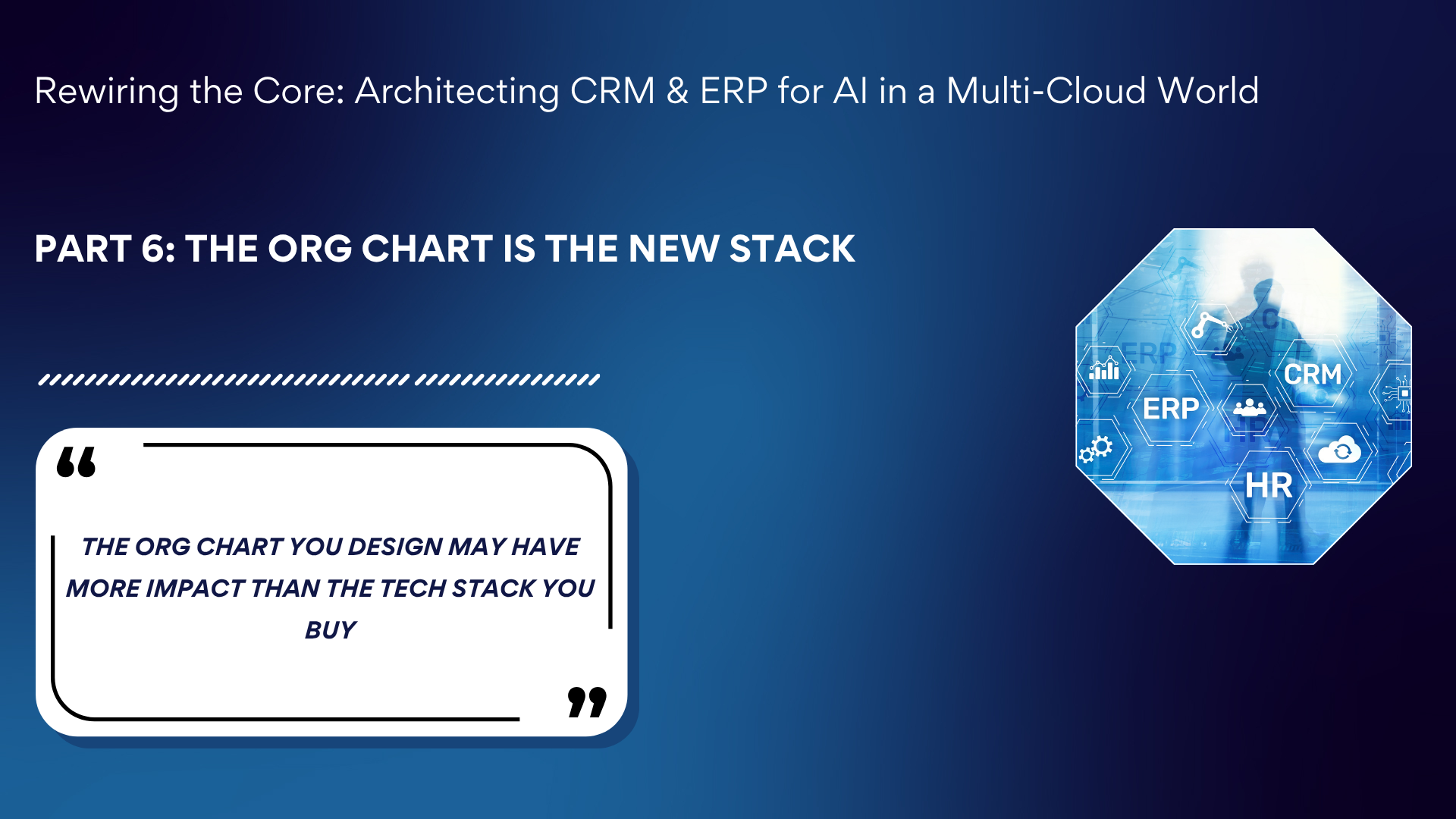
The org chart you design may have more impact than the tech stack you buy.
Up Next:
Part 7: Wrap Up!