


Table Of Content
Part 3 : Your Data Warehouse is the New Brainstem
Recap:
In Part 1, we talked about the foundational mismatch between traditional ERP/CRM systems and the demands of AI. While these platforms excel at transactions, they were not built to provide intelligence or predictive insights.
Part 2 highlighted the critical role of data quality. We saw that before you can dream of AI-driven transformation, you need to address the messy, scattered, and inconsistent data that too often lives across enterprise systems.
Now, in Part 3, we move to the centerpiece of modern enterprise data strategy: the data warehouse (or lakehouse). Earlier it used to be a reporting store, but now, it has become the “brainstem” that connects, activates, and powers intelligence across your entire business landscape.
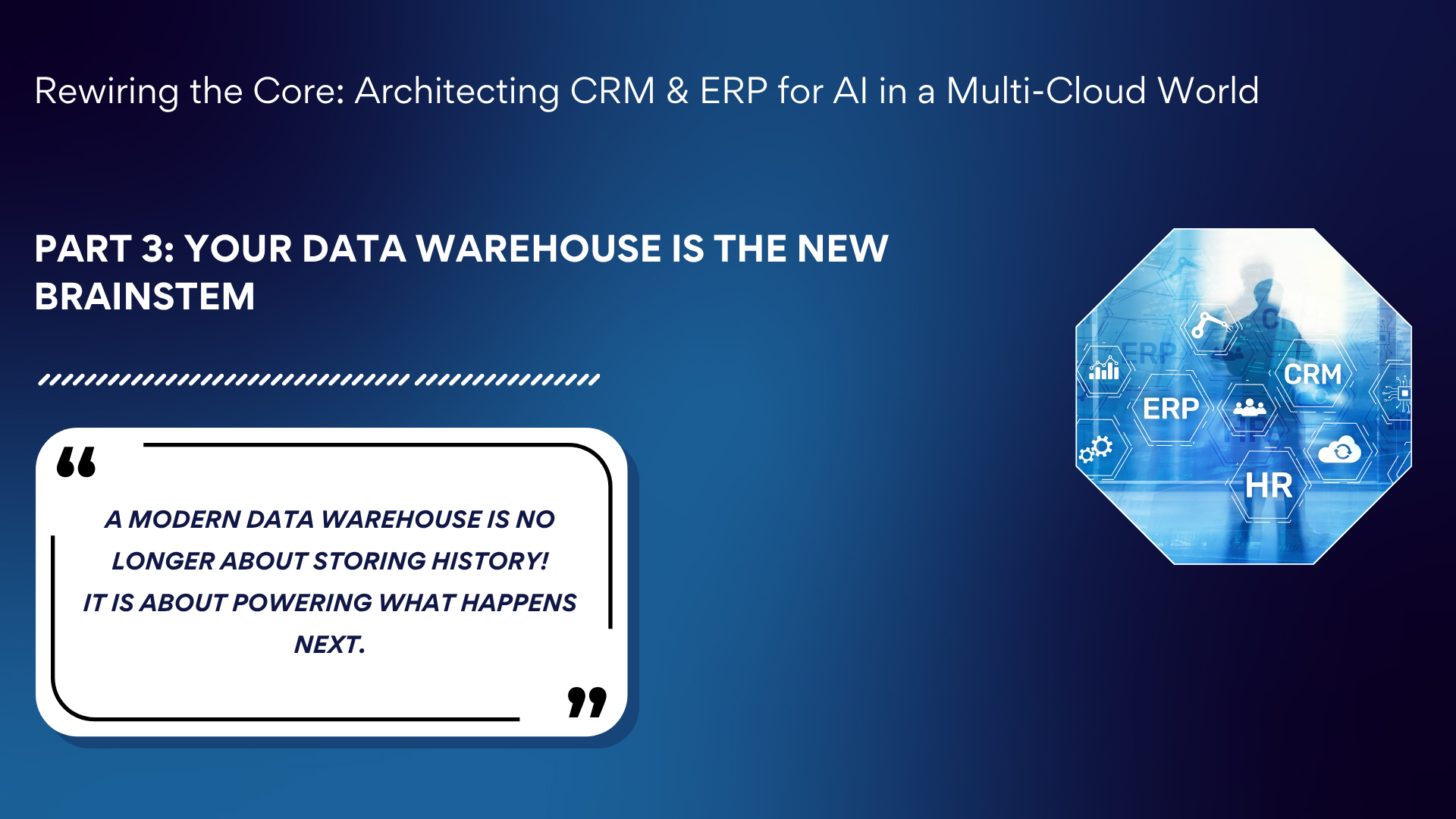
A modern data warehouse is no longer about storing history! It is about powering what happens next.
Beyond Reports: The True Role of Your Data Warehouse
Most organizations still treat the data warehouse as a back-office reporting store more like a place for BI dashboards, not real-time business value. But as AI, automation, and analytics move to the forefront, your data warehouse (or lakehouse) has a new role: it is the nerve center that feeds insight and action to every part of your business.
From CRM and ERP Transactions to Curated Data
The best-run architectures now follow this pattern:
- CRM and ERP systems remain the systems of record for processing transactions, orders, and customer activity.
- These systems push curated, trusted data into a centralized data warehouse or lakehouse.
- This curated layer which is cleaned, governed, and standardized becomes the single version of the truth for analytics, AI, and advanced automation.
This way, You decouple heavy transaction workloads from analytics and innovation without losing fidelity or trust in the data.
Multi-Cloud: The New Normal (and the New Challenge)
But there is a twist: Your AI/ML engines rarely live in the same place as your ERP/CRM or even your data warehouse.
- ERP may be on-premises or in a private cloud
- CRM might be SaaS, like Salesforce or Dynamics
- Your data warehouse (Snowflake, Databricks, Synapse, BigQuery) is likely cloud-native
- AI/ML tools may be in yet another cloud (Azure, AWS, GCP) or external platform
This “sprawl” means your architecture has to do more than centralize data i.e. it needs to make data available everywhere business value is created.
How Architects Are Bridging the Divide
So how do leading enterprises turn this challenge into an advantage?
- Real-time data pipelines: Modern architectures use streaming or event-driven pipelines (e.g., Kafka, Azure Event Hubs) to move data from ERP/CRM into the warehouse as events happen.
- APIs and Data Contracts: Well-defined APIs, data contracts, and shared schemas ensure every system irrespective of where it lives gets the right data, in the right format, at the right time.
- Reverse ETL: It’s not just about pushing data into the warehouse; sometimes, you need to send curated, enriched data back into operational systems so business users see the same “truth” in their everyday tools.
- Unified governance: Metadata management and data lineage tracking across clouds and platforms mean you always know where your data came from, how it changed, and whether it can be trusted.
Business Impact: Why It Matters
When your data warehouse becomes your architectural brainstem:
- AI/ML models train on the most accurate, up-to-date data.
- Analytics are faster and more relevant.
- Business decisions are grounded in a single, trusted source—no more “multiple versions of the truth.”
- You gain agility: experiment in one cloud, deploy insights in another, and feed back improvements to the source.
If your data warehouse still feels like a dusty attic of old reports, it is high time to rewire your thinking. Make it your active hub that connects every system, every cloud, and every outcome.
Next Up:
Part 4: The Cloud Divide—Making ERP, CRM, and AI Work in a Multi-Cloud World